
Learn How To Manage Your Rental Property on Airbnb
Get access to our 5-day training course on managing your vacation rental property in Dubai.
Download GuideWant to list your Dubai apartment or villa on Airbnb?
You’ll need a DTCM holiday home permit before you can start taking bookings.
The permit process is handled through Dubai’s Department of Economy and Tourism (DET), with specific requirements for documents, fees and renewals.
At Homevy, we’ve spent over two years managing holiday homes in Dubai and regularly help property owners navigate DTCM permit applications and compliance.
We also checked DET’s Holiday Homes System User Guide and Dubai’s holiday home legislation to ensure this guide reflects the current requirements.
In this guide, you’ll learn who can apply for a DTCM permit, which documents you need, how much it costs, how long it lasts and when to renew it.
A DTCM holiday home permit is DET’s official approval for a furnished apartment or villa in Dubai to operate as a short-term rental.
The name comes from the Department of Tourism and Commerce Marketing (DTCM), which was Dubai’s former tourism authority.
In 2021, Dubai merged its tourism and economy departments under the Department of Economy and Tourism (DET). DTCM is no longer a separate authority.
Under Law No. 20 of 2021, DET was established as a government department affiliated with Dubai’s Executive Council. So today, when someone says “DTCM permit,” they mean the DET holiday home permit.
There are two terms worth separating because they are not the same:
This matters because each holiday home needs its own permit.
If you own three apartments and want to operate all three as holiday homes, you need three separate permits. DET requires every apartment and villa to be registered and approved before it is listed
Both individual property owners and licensed holiday home operators can apply for a holiday home permit in Dubai.
Image by Homevy
You qualify if you:
You can register directly as a Home Owner. Three official rules apply:
A holiday home operator needs a trade licence with Vacation Homes Rental listed as the activity.
The manager’s name on the application must match the trade licence, and DET may require a physical or virtual inspection before approving the operator.
If you’re a tenant planning to operate a holiday home, you’ll need to meet both tenancy law and DET requirements.
You’ll also need the owner’s authorisation on DET’s approved form. We explain the landlord’s side of the process in our guide to subletting regulations in Dubai.
Plus… the property must also meet DET’s requirements. It needs to be an eligible apartment or villa in an area where holiday home activity is permitted, and the sale and purchase agreement (SPA) must not prohibit it.
Under Dubai’s implementing rules, the unit must fall into one of these four categories:
You also need to prove that you have the right to dispose of the property, and the SPA must not contain a provision that explicitly blocks holiday home use.
Homevy Tip: Check your building or community rules before paying for the permit. Some communities have their own check-in and access procedures in addition to DET requirements. Emaar’s check-in policy is one example of how building-level rules can affect your operation.
Before you apply for a DTCM holiday home permit, make sure you have the required documents ready. For most applications, the core documents are:
Company-owned units may require additional company documents, while operators need a valid Vacation Homes Rental trade licence.
Missing documents or mismatched information can delay your application.
| Document | Who needs it | Requirement |
| Emirates ID for account registration | Individual owners | Required by DET |
| Passport or Emirates ID for the permit | Individual owners | Required by DET |
| Owner or partner ID, plus licence or articles of association | Company-owned units | Required by DET |
| Title deed copy | All applicants | Required by DET |
| Owner authorisation on DET’s approved form | All applicants | Required by DET |
| DEWA bill in the owner’s or licensee’s name | All applicants | Required by DET |
| Valid Vacation Homes Rental trade licence | Operators | Required by DET |
| Proof of first-degree relationship | Relatives registering for an owner | Only where applicable |
Homevy Tip: Open your title deed, Emirates ID and DEWA account before you start the application. Check the names letter by letter. A small mismatch is easier to fix before you submit than after your application gets held up.
You apply for a DTCM holiday home permit online through DET’s Holiday Homes System.
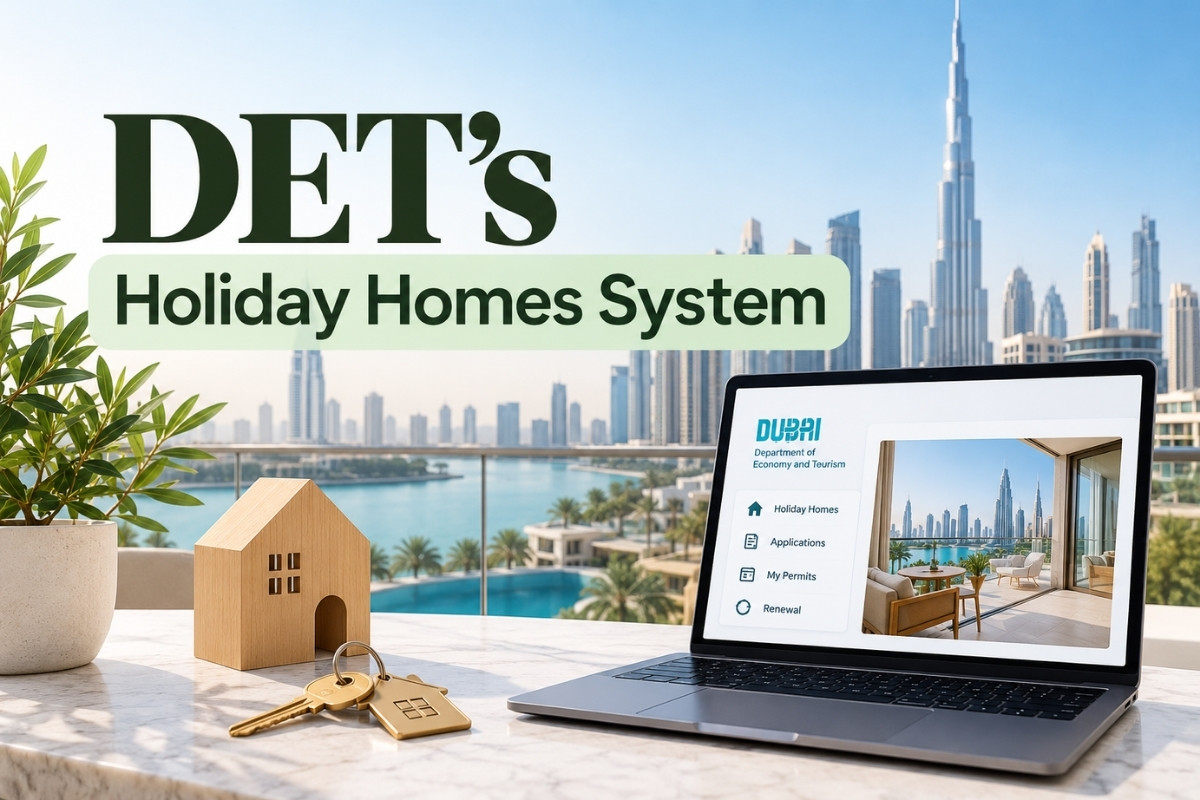
Image by Homevy
The process has three main stages:
Here’s what each stage looks like.
DET sends your username and password by email after registration.
Once your registration is approved, you’ll receive a payment link for the registration fee. The payment permission is valid for one month, and your account is activated after payment.
Once your account is active:
There’s also a useful shortcut if you’re applying through the DLD route.
Enter the Deed Number, Unit Type and Unit Deed Number, and much of the property information will populate automatically.
The DLD route also triggers an email to the property owner asking them to approve the application after submission.
Homevy Tip: Applying on behalf of an owner who lives abroad? Let them know to expect this email before you submit. Otherwise, the approval request could sit unread and hold up the application.
Once DET approves the unit application, you need to classify the property. Dubai holiday homes are classified as either Deluxe or Standard.
Once payment is completed, the application is approved automatically. You then print the electronic permit and display it somewhere visible inside the holiday home.
Homevy Tip: Don’t treat the classification pledge as a formality. Make sure the property meets the requirements before you start hosting. Our Airbnb essentials inventory can help you check what you need.
You can pay online, by bank transfer, cash deposit or cheque deposit. DET recommends paying online because offline payments need to be reviewed and confirmed by its finance team before the application is approved.
DET says holiday home applications are reviewed within one business day. For account registration, activation follows within one business day after DET receives your payment.
There’s no single timeline from application to permit because a few steps depend on you, the property owner or any inspection DET requires.
Image by Homevy
Your timeline can depend on:
So while you may see faster timelines quoted in online guides or owner experiences, those are individual experiences, not timelines guaranteed by DET.
The easiest way to avoid unnecessary delays is to have your documents ready, check that the details match and respond to DET requests promptly.
You renew a DTCM holiday home permit through DET’s Holiday Homes System.
Each permit is valid for one year, and you need to apply for renewal before it expires if you want to continue renting the property.
The renewal process is straightforward:
There’s an important detail to watch. The Renew button only appears 30 days before the permit expires.
If you miss that window, the permit expires and can no longer be renewed through the renewal process. We also didn’t find an official grace period in the sources reviewed.
Homevy Tip: Set a reminder 45 days before your permit expires. That gives you time to check your documents before the renewal window opens.
If you’d rather not keep track of permit dates, documents and DET requirements yourself, Homevy can handle the renewal process for you.
For property owners who want to rent their apartment or villa as a short-term rental, we manage the DET permit process, renewals and ongoing compliance for the properties we manage.
That means you can hand over the administrative work while Homevy handles the operational side of getting and keeping your property ready for short-term guests.
Getting your permit is only the beginning. Once your holiday home is approved, there are several requirements to keep up with:
Most DTCM permit delays come down to a few avoidable mistakes. Mismatched names, the wrong DEWA bill, an expired payment link and a missed renewal window can all create unnecessary delays.
Before you apply, check these six points:
If you’d rather not keep track of these requirements yourself, Homevy can handle the permit process, renewals and ongoing compliance for the Dubai properties we manage.
That gives you a way to put your property into short-term rental without having to manage every DET requirement yourself.
A DTCM permit is the common name for a holiday home permit issued by Dubai’s Department of Economy and Tourism (DET). It approves a specific furnished apartment or villa for short-term rental.
You need one permit per unit before listing the property on Airbnb, Booking.com or another platform.
DTCM stands for the Department of Tourism and Commerce Marketing. It was Dubai’s tourism authority until 2021, when Law No. 20 established the Department of Economy and Tourism (DET).
DET now issues and administers holiday home permits.
DET’s portal charges AED 370 per year for a studio or one-bedroom unit, plus AED 300 for each additional bedroom, up to AED 1,270 per unit.
A one-off account registration fee also applies when you first join the system.
Register on DET’s Holiday Homes System as a Home Owner or Operator, then add your unit and upload the required documents.
Once DET approves the application, classify the unit and pay the required fees. The permit is then issued automatically.
No. DET requires every apartment and villa to be registered and approved before it is listed.
Dubai’s fee schedule includes fines such as AED 5,000 for conducting the activity without a licence. Repeat violations within one year can result in doubled fines, subject to the applicable maximum.
A DTCM holiday home permit is valid for one year.
You can renew it for another year, but the Renew button only appears 30 days before the permit expires.
If you don’t renew within the permitted renewal window, the permit expires and cannot be renewed through that renewal process. DET may also suspend or revoke a permit in accordance with the applicable rules.
Do not continue hosting guests on an expired permit.
Yes. For properties that Homevy manages, we handle the permit application, classification, renewals and ongoing compliance.
That means property owners who want to rent their Dubai property as a short-term rental don’t have to manage the DET process and renewal deadlines themselves.
Getting a DTCM permit is one thing. Keeping your property compliant while guests are coming and going is another.
Homevy handles DTCM permit applications, renewals, cancellations and appeals for the Dubai properties we manage.
We also handle the daily operational work, including guest management, housekeeping, maintenance and property compliance, so owners don’t have to manage every requirement themselves.
That work has earned Homevy the 2026 Arabian Best of the Best Award for Best Short-Term Rental Management Company in Dubai.
So if you want to turn your Dubai property into a short-term rental but don’t want to navigate the DET portal, track renewal dates or manage every compliance requirement yourself, Homevy can handle it for you.

Get access to our 5-day training course on managing your vacation rental property in Dubai.
Download Guide