
Learn How To Manage Your Rental Property on Airbnb
Get access to our 5-day training course on managing your vacation rental property in Dubai.
Download Guide
The keys are in your hand. The apartment is finished. And the first post-handover instalment is due next month.
You’d planned for the rent to cover it. Now the rent is lower than you expected, the tenant wants twelve cheques instead of one, and the service charge bill just arrived.
Sound familiar?
At Homevy, we speak to property owners in exactly this spot every month. Many of them aren’t wealthy investors who can leave a unit empty. They need the property to pay its own bills. So let’s look at how post-handover payment plans in Dubai work, why rent so often falls short of the instalment, and what you can do about it.
A post-handover payment plan in Dubai lets you pay part of an off-plan property’s price after the developer hands you the keys. Typically 20% to 50% of the price is spread over one to five years after handover, in monthly, quarterly or lump-sum instalments. The terms are set by the developer and written into your sales agreement.
You’ll see plans described by their split. A 60/40 plan, for example, means 60% paid before and at handover and 40% after. Some plans spread the post-handover balance at 1% a month. Others ask for larger payments every six months, according to Kredium’s overview of Dubai plans.
| Plan type | Paid before handover | Paid after handover | A published example of how it’s spread |
|---|---|---|---|
| 80/20 | 80% | 20% | 20% within 24 months (Cloud Tower) |
| 70/30 | 70% | 30% | 30% within 24 months (Seslia Tower) |
| 60/40 | 60% | 40% | 40% over 2 years (Maimoon Gardens) |
| 50/50 | 50% | 50% | 50% over 48 months (Nobles Tower) |
The appeal is obvious. You get the keys earlier, and you can rent the unit out while you’re still paying for it. The catch is what happens when that rent doesn’t stretch as far as you planned.
Rent rarely covers a post-handover instalment because the plan compresses a large share of the price into a few years, while rent earns a gross yield of around 5% to 6% a year. On most Dubai apartments, the monthly instalment is two or three times the monthly rent, before service charges.
Here’s an illustrative example. Take an AED 1.2 million apartment on a 60/40 plan, with AED 480,000 due after handover. We’ve used the 5.53% average gross yield for Dubai apartments in Q2 2026 from Global Property Guide and a service charge of AED 18 per sq ft, the Business Bay average per Real Estate Club Dubai, on 750 sq ft.
| Per month (AED) | 24-month plan | 48-month plan |
|---|---|---|
| Post-handover instalment | 20,000 | 10,000 |
| Gross rent at 5.53% yield | 5,530 | 5,530 |
| Service charge | 1,125 | 1,125 |
| Rent left after service charge | 4,405 | 4,405 |
| Gap you cover yourself | 15,595 | 5,595 |
These are example figures, not a forecast for your unit. But the shape is the same for most buyers: the plan is financing, and the rent only reduces how much you top up.
If an agent told you the rent would pay the instalments, ask them to show you this table for your unit.
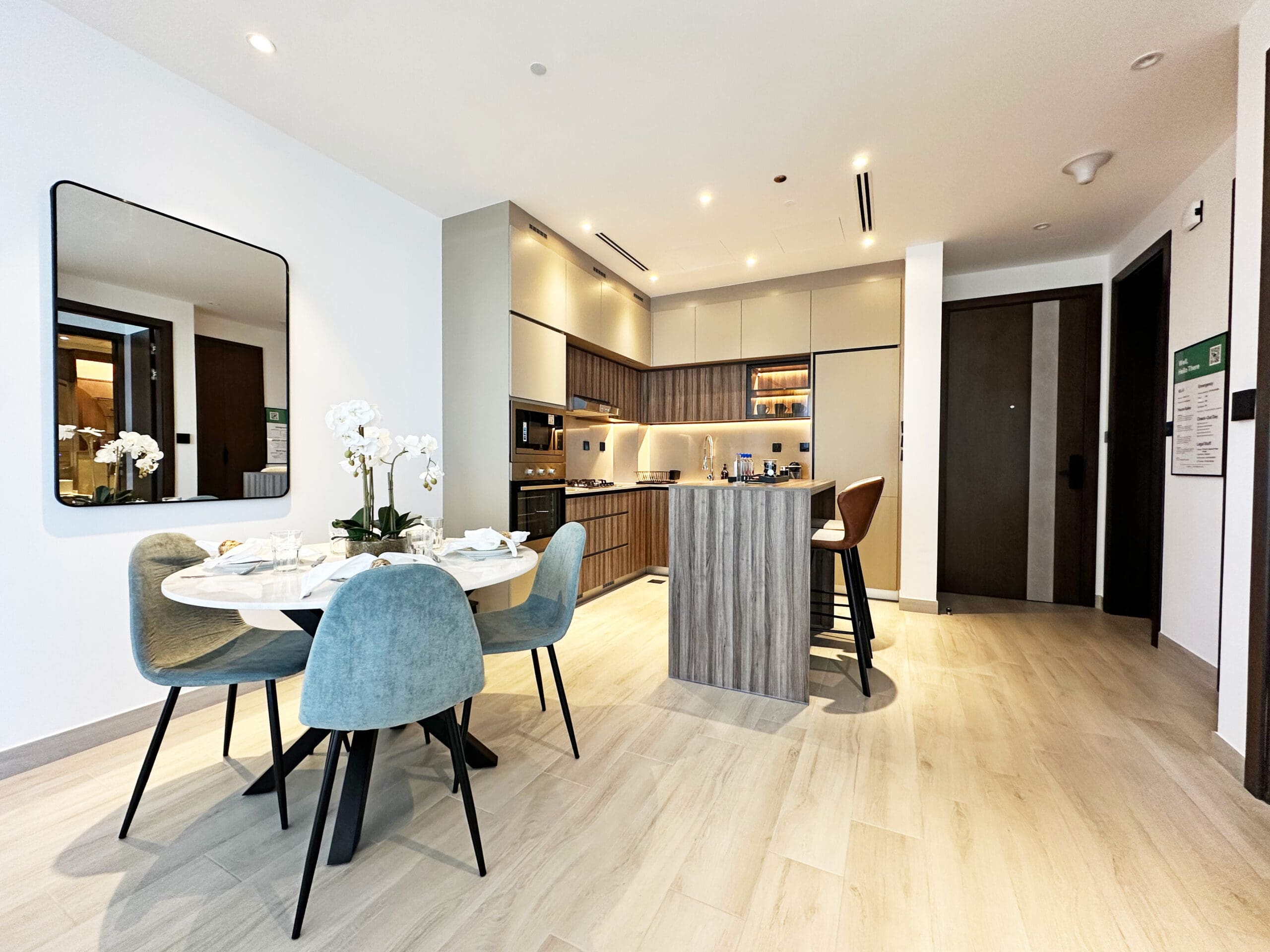
Landlords on a post-handover plan often lose money by holding out for the rent they were promised. If tenants are offering AED 85,000 and you wait months for AED 100,000, every empty month means paying the full instalment and service charge from your own pocket. In most cases, the wait costs more than the discount.
I see this all the time. An agent told the owner his one-bed would rent for AED 100,000. The building does do AED 100,000… but there are now so many similar units that a tenant can view five and offer AED 85,000 on all of them. One owner says yes. The owner fixed on AED 100,000 waits.
Run the numbers. Accepting AED 85,000 costs you AED 15,000 a year against your target. Leaving it empty for two months at AED 100,000 costs you about AED 16,700 in lost rent, and you’re still paying the instalment in full. The discount was cheaper.
It’s a double-edged sword, I know. You need a certain amount for the property to make sense. But the market sets the rent, not the number in your head.
On a post-handover plan, the right rental strategy is the one that keeps money coming in every month at the highest net level your unit can earn. Short stays can earn more where the property suits them and pay out monthly. A yearly lease gives certainty, but tenants in 2026 increasingly want more cheques and shorter commitments.
Tenants used to pay in one or two cheques. Now many ask for four or twelve, and some want to rent a quarter at a time in case they need to leave Dubai quickly. The Dubai Land Department’s Flexi Rent scheme, launched on 23 June 2026, lets tenants spread rent across more instalments, per The National.
| Yearly lease | Short stays with a manager | |
|---|---|---|
| Income timing | Cheques, now often 4 to 12 a year | Monthly payouts; Homevy pays within the first week |
| Income level | Fixed for the year | Varies by season; Homevy property owners earn at least 20% more than a yearly lease, where the property suits short stays |
| Upfront cost | Low | Furnishing, which Homevy can front for qualifying properties and deduct from future income |
| Flexibility | Locked for 12 months | Free, unlimited owner stays; easier to switch later |
| Risk | Vacancy between tenants | Seasonality and empty nights |
Neither option is right for every unit. Our STR vs LTR calculator shows how the two compare for yours.

You plan for a post-handover payment plan by working out the monthly gap before you sign, not after you get the keys. Compare the instalment with a conservative rent, subtract the service charge, and make sure you can cover the difference for the full length of the plan, including a few empty months.
Homevy Tip: If your unit will be ready within the next year, talk to a manager now. Furnishing, photography and a DTCM permit take time, and every week before your first booking is a week you’re paying the instalment alone. Our in-house interior design and furnishing team can get a property guest-ready fast.
It’s an off-plan payment structure where part of the price, often 20% to 50%, is paid after you receive the keys, usually over one to five years. The developer sets the terms in your sales agreement.
In most cases, yes, once you have the keys. For short stays, you’ll also need a DTCM holiday home permit, and the building must allow holiday homes. Check your sales agreement for any developer conditions.
On most Dubai apartments, no. At a gross yield of around 5% to 6%, monthly rent is usually well below the monthly instalment, so plan to top up the difference for the length of the plan.
It depends on your sales agreement, which sets out late-payment penalties, default terms and when the title deed transfers. Read that clause before signing, and speak to a licensed legal advisor if anything is unclear.
It can be, where the property suits short stays. Homevy property owners earn at least 20% more than a yearly lease in those cases, with monthly payouts. Our STR vs LTR calculator shows how the two compare for your unit.
Yes. Homevy handles furnishing, photography, the DTCM permit, pricing and guest care, so your property can take bookings sooner. Furnishing can be fronted for qualifying properties and deducted from future income. Occupancy and income vary by unit, area and season.
A post-handover payment plan in Dubai is a way to finance your property, not a way to have it pay for itself. On most units, the rent reduces your monthly top-up. It rarely replaces it.
So plan for the gap before you sign. Use a conservative rent, budget for empty months, and don’t let an old rent target keep your property empty while the instalments keep coming.
If you want to see what your unit could earn on short stays, Homevy, Dubai’s most intentional holiday homes company, can show you an honest range. Estimate what your property could earn, or request a callback on +971 56 496 6100.
Ciao!

Thank you for reading! I'm excited to help homeowners and guests alike discover the benefits of short-term rentals with HOMEVY. Stay tuned for more updates and helpful tips on the blog.



Get access to our 5-day training course on managing your vacation rental property in Dubai.
Download Guide