


Learn How To Manage Your Rental Property on Airbnb
Get access to our 5-day training course on managing your vacation rental property in Dubai.
Download Guide
Airbnb revenue management starts with questioning whether you’re charging the right price each night.
In Dubai, a price that made sense last month might be too low during a major event, too high during a quiet summer week, or completely wrong when guests suddenly start booking further ahead.
That’s why your airbnb smart pricing strategy needs to respond to what’s happening in the market.
At Homevy, we’ve spent the last two years managing properties in Dubai across 10,000+ booked nights, and we’ve seen how these patterns affect revenue.
Our approach to short term rental revenue management combines what we’ve learned with our in-house dynamic pricing tool that helps us respond to market changes and maximise returns for the properties we manage.
Airbnb revenue management means adjusting your nightly price, minimum stay and availability based on demand, so you can earn more from the nights your property has available.

Photo by Kuncheek
It’s all about finding the best balance between what guests will pay and how often your property gets booked.
That comes down to four numbers: ADR, occupancy, RevPAR and booking window.
Here are the four factors that tell you what’s actually happening:
| Metric | What it means | What it tells you |
| ADR (average daily rate) | Your average price per booked night | Whether guests are paying what your property is worth |
| Occupancy rate | Booked nights divided by available nights | Whether your pricing is attracting enough guests |
| RevPAR (revenue per available night) | Total revenue divided by available nights, or ADR × occupancy | Whether your pricing is actually working |
| Booking window | How far in advance guests book | When to raise prices and when to adjust them |
RevPAR is one of the most essential factors to watch because it combines price and occupancy.
It gives you a clearer picture of whether your pricing is actually working, rather than allowing one metric to look good while the other suffers.
This means that two identical one-bedroom apartments in the same Business Bay building can perform very differently.
Here’s how:
| Item | Apartment A | Apartment B |
| Nightly rate (ADR) | AED 600 | AED 480 |
| Occupancy | 60% (18 nights) | 90% (27 nights) |
| Monthly revenue | AED 10,800 | AED 12,960 |
| RevPAR | AED 360 | AED 432 |
Apartment A charges more per night, but Apartment B makes AED 2,160 more that month because it combines a lower rate with much stronger occupancy.
Now flip the scenario. If Apartment B dropped its rate to AED 350 to reach 100% occupancy, it would make AED 10,500, which is less than both.
The point is not to maximise your nightly rate or fill every night on your calendar. It’s to find the price that gives you the strongest overall return.
That’s what makes short-term rental revenue management more nuanced than simply picking a nightly rate and waiting for bookings. Your ideal price can change from one night to the next depending on what the market is telling you.
Your Airbnb price should start with a realistic base rate, then change as the market around it changes. Seasonality, local events, booking patterns, length of stay and listing quality can all affect what guests are willing to pay.

Photo by Andrii Yalanskyi
If you’re wondering how to price an Airbnb in Dubai, here are some factors that are relevant.
Your base rate is your “normal night” price.
Set it against properties guests would actually compare with yours: similar location, number of bedrooms, views and amenities.
In Dubai, a one-bedroom with a Burj Khalifa view in Downtown isn’t competing with a one-bedroom in JVC, where there may be far more listings competing for the same guests.
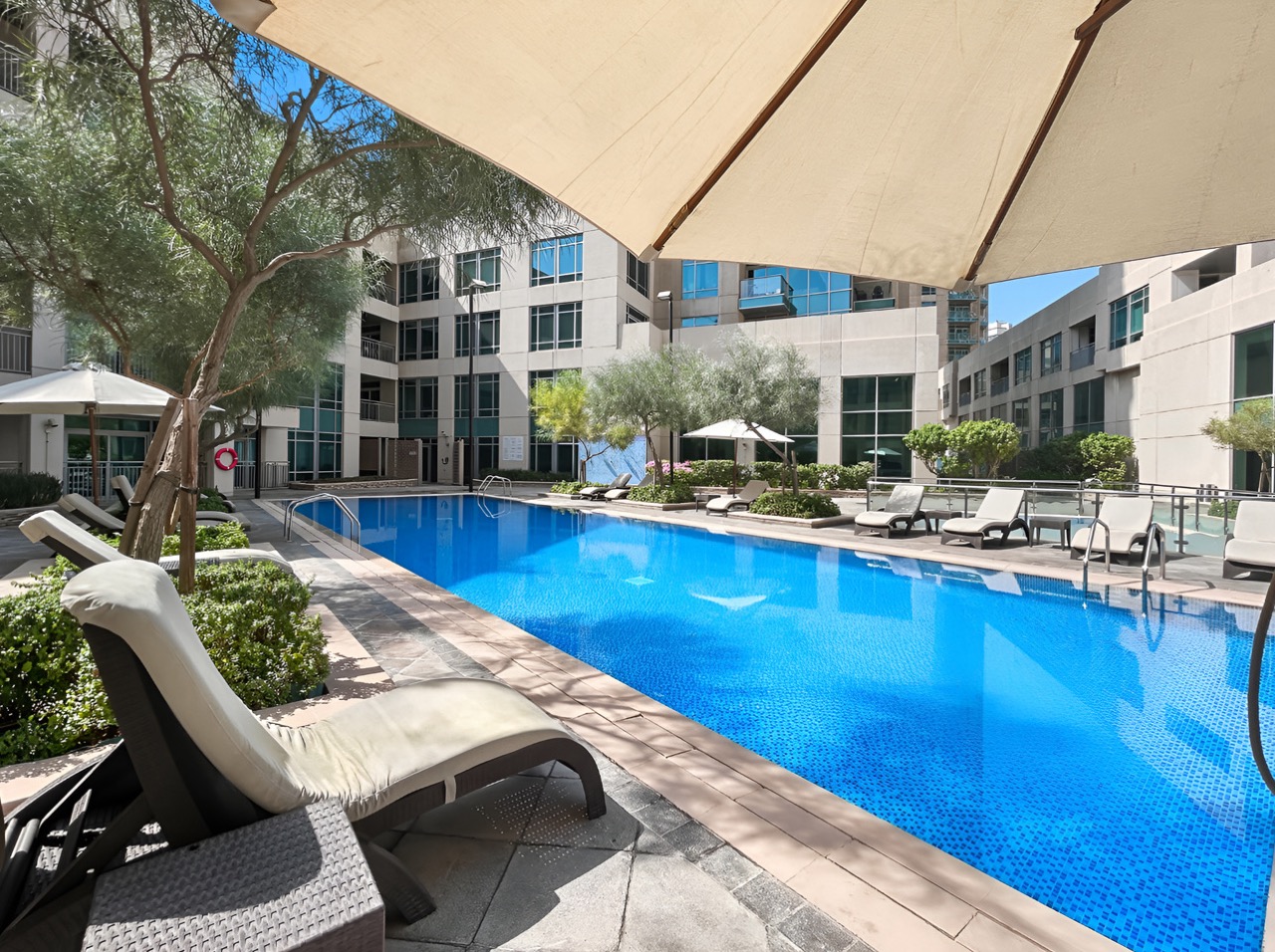
Photo by Homevy
Good airbnb revenue management starts with knowing what’s realistic.
You can estimate what your Dubai property could earn with our free calculator, then use that estimate as a benchmark for your nightly pricing.
Ramadan, summer, major events, and unforeseen circumstances can all change how much guests are willing to pay, how far ahead they book and how long they stay.
In February 2026, as Ramadan approached, Dubai’s average ADR fell 12.5% to AED 910, while RevPAR dropped 11.9% to AED 687.
We adjusted our pricing as demand patterns changed rather than waiting for bookings to slow down.
By February 28, the US-Iran war began, followed by airspace closures, flight cancellations and travel advisories.
In March, Dubai’s average short-term rental occupancy had fallen to 43.2%. Homevy responded by shifting properties towards longer and monthly stays as the guest mix changed.
The lesson is that seasonality tells you what is likely to happen, while events can change the market overnight. Your pricing strategy needs to account for both.
How far ahead guests book tells you when to act.
If your dates are still empty within the usual booking window for your area, demand may not be strong enough at your current price. But if guests are booking weeks or months ahead, dropping your rate could mean giving away revenue you didn’t need to discount.
We saw this shift in our August 2026 Monthly Index, which found Dubai’s booking windows getting shorter, with more guests booking closer to arrival.
That changes how you price: an empty date a month away doesn’t necessarily mean your rate is too high. It may simply be too early to react.
Homevy Tip: Before dropping your rate, check how far ahead similar properties are booking. You may be looking at an empty calendar when you should really be looking at the booking window.
At Homevy, we don’t treat minimum stays as a fixed rule.
When demand shifted during the US-Iran war in March 2026, Dubai’s average stay duration increased to 10 nights, even as occupancy fell to 43.2%. That told us that the guests still booking were staying longer.
So instead of chasing short tourist bookings that weren’t coming, we repositioned properties for longer and monthly stays.
By April, we were targeting 30-day stays, offering weekly and monthly incentives, and adapting properties to meet the needs of guests staying for longer.
We also pushed three- to six-month stays as a middle ground between nightly rentals and a 12-month lease. This gave owners more consistent occupancy without locking their properties into a long-term contract while the market was recovering.
The lesson for hosts is that your minimum stay should reflect the demand in front of you. Sometimes that means opening up one-night gaps. At other times, it means encouraging guests to stay for weeks or months.
This is also a good example of why airbnb revenue management is about more than changing the nightly rate. Sometimes the best way to improve revenue is to change what kind of booking you’re trying to attract.
No pricing strategy can sell a property guests don’t want to stay in.
Photos, furnishing, amenities and reviews decide how high your rate can go before guests choose the listing next door. That’s why pricing and property quality can’t be separated.
Take Anthony’s property for example.
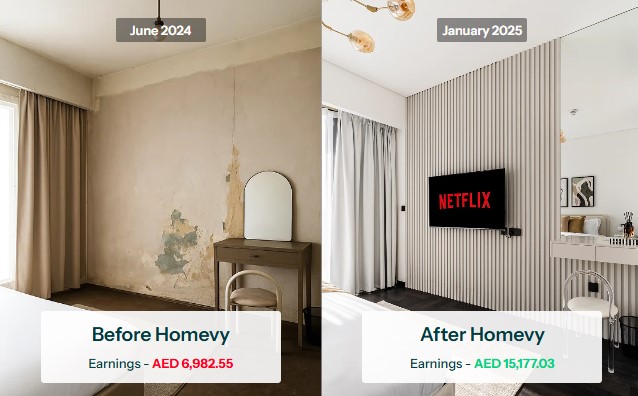
Photo by Homevy
After our team elevated his interior and chose furniture that suited both the apartment and the guests it was attracting, his ROI rose 20% within a year compared to his previous long-term rental income.
Guests kept mentioning the apartment’s comfort, usability and style in their reviews. Better reviews give a property room to price higher, and keep it booking when it does.
Not sure what’s holding your listing back ? Homevy Score audits your Airbnb listing and shows you what to fix.
Airbnb revenue management matters most when the market stops behaving normally.

Photo by Axel Makhalov
During the US-Iran war in March, average booking lead time dropped to 4.5 days and that contributed to how we adjusted the way we were selling our properties.
We responded by:
Our goal was to find where demand had moved and position each property accordingly.
The Homevy’s March Index shows that we finished the month at 65.1% occupancy, compared with 43.2% across the Dubai market, while our average stay reached 13.9 nights.
As the market recovered in April, Dubai’s average occupancy rose from 43.2% to 44.2%, while Homevy reached 84.5%.
Average stay duration across the market also increased to 13.2 nights, reinforcing the shift towards longer stays.
By May, Homevy reached 93.3% occupancy, higher than our January occupancy of 91.4%, before the conflict disrupted the market.
We kept monthly and weekly inventory available for longer-stay guests while reopening short-stay availability on suitable properties as tourist demand returned.
The gap continued into the summer:
| Month (2026) | Homevy occupancy | Dubai Airbnb market occupancy |
| June | 85.1% | 55.9% |
| July | 87.0% | 55.7% |
Source: Homevy Monthly Index, June 2026 and July 2026.
By August, Dubai’s market occupancy had recovered to 59.94%, while booking lead times shortened again to 2.63 days. Homevy finished the month at 89.58% occupancy.
The biggest lesson we picked during this period is to stop pricing for the market and start responding to the market we had.
That’s what revenue management looks like in practice. The strategy isn’t to keep lowering your price whenever bookings slow down.
It’s to understand why demand has changed, identify where the opportunity has moved and adjust before an empty calendar makes the decision for you.
We also kept owners informed throughout the period rather than promising returns the market couldn’t deliver. As Usman, one of our property owners, told us:
“It’s truly impressive how you guys have been transparent with me through this entire period.”
If you’re considering a bigger change in your rental strategy, speak with the Homevy team about managing your property.
Homevy’s dynamic pricing combines AI-assisted technology with a team that monitors the Dubai short-term rental market.
Photo by Homevy
Our pricing approach responds to factors such as:
Most hosts start with Airbnb’s own Smart Pricing, so let’s begin there.
Airbnb Smart Pricing automatically adjusts your nightly price based on demand. Airbnb says the tool uses hundreds of factors about your listing and area, while allowing you to set a minimum and maximum price.
You can also override the suggested price for individual nights.
For a host managing one Airbnb listing, that’s a useful starting point. But it has some limitations:
So Smart Pricing can automate part of the pricing process. It isn’t the same thing as a complete revenue management strategy.
Homevy’s approach goes beyond adjusting the nightly rate.
Our AI-assisted pricing responds to market signals, while our team monitors what is happening across Dubai and makes broader revenue decisions when needed.
| Airbnb Smart Pricing | Homevy’s dynamic pricing approach | |
| Primary purpose | Automatically adjust Airbnb nightly prices | Adjust pricing as part of a broader revenue strategy |
| Pricing signals | Demand and factors about your listing and area | Demand, seasonality, events and competitive positioning |
| Channels | Airbnb | Multiple booking channels |
| Human oversight | Host manages the settings and overrides | Homevy’s team monitors the Dubai market |
| Beyond nightly price | Airbnb also provides separate tools for discounts, weekend pricing and stay requirements | Pricing decisions can be considered alongside minimum stays, longer bookings and channel strategy |
| Owner visibility | Airbnb calendar | Homevy’s owner reporting and dashboard |
The technology helps us respond to pricing signals quickly across the properties we manage.
The team then looks at the wider picture:
That distinction is essential because dynamic pricing changes the rate. Revenue management asks whether changing the rate is actually the right move.
According to the Homevy Monthly Index, the Dubai Airbnb market averaged between about 56% and 60% occupancy in summer 2026, while Homevy-managed properties ran at 85.1% in June and 89.1% in July.
But occupancy alone doesn’t tell you whether your pricing works. A property at 90% occupancy can earn less than one at 75% if it’s underpriced, so judge it with RevPAR.
Airbnb offers dynamic pricing through Smart Pricing, an optional feature that adjusts your nightly rate based on demand within a minimum and maximum you set. It isn’t switched on automatically, and you can override any night.
Many hosts and management companies use their own dynamic pricing systems instead, because Smart Pricing only prices your Airbnb listing.
Review your prices at least weekly, and check event dates and last-minute gaps more often. In a market as fast-moving as Dubai, rates can need adjusting daily, especially when booking windows are short.
A dynamic pricing system makes routine changes automatically, but someone still needs to review the strategy behind them.
Usually, yes, but strategically. Drop your rate from its winter level, shorten minimum stays to fill gaps, and consider monthly stays for longer summer guests.
Avoid cutting too early: with shorter booking windows, many summer guests book close to arrival, and a premature discount sells nights that might have booked at full price.
Homevy uses in-house dynamic pricing that combines data analytics and AI-powered tools with a team that monitors the Dubai market.
The system reads demand, seasonality, events, location, property size, amenities and market conditions, then adjusts rates automatically.
The team steps in for events, market shocks and strategy changes such as switching to monthly stays.
If you manage one property and have time to monitor the market, you can build a pricing strategy yourself. But pricing is only one part of running a holiday home.
Guest messages, check-ins, cleaning, maintenance and reviews can quickly turn a “passive” investment into a part-time job, especially when guests need help outside working hours.
At Homevy’ we’ve spent the last two years helping owners maximize their property’s revenue. A good example is Anthony, one of Homevy’s property owner who went from earning AED 6,982.55 to AED 15,177.03.
Our dynamic pricing and optimisation combines in-house technology with our team’s knowledge of Dubai’s short-term rental market.
We monitor how demand is changing, adjust pricing and stay strategies when conditions shift, and look at the wider performance of each property rather than treating the nightly rate in isolation.
You can also see how your property is performing through the Owner Dashboard, without having to manage the day-to-day operation yourself.
For every property we manage, our goal is to make the property perform well without turning your passive investment into another full-time job.
Want to know if your property is priced right? Send us your property details on WhatsApp and we’ll give you an honest view of what it could earn.

Get access to our 5-day training course on managing your vacation rental property in Dubai.
Download Guide