

Learn How To Manage Your Rental Property on Airbnb
Get access to our 5-day training course on managing your vacation rental property in Dubai.
Download GuideAirbnb arbitrage is when you lease a property long-term, furnish it and rent it out short-term on Airbnb or other booking platforms.
It seems like a lovely way to make passive income, right?
Well, in reality, the gap between rent and Airbnb revenue isn’t your profit.
You still have furnishing, cleaning, utilities, maintenance and platform fees to cover.
And your landlord saying “sure, go ahead” doesn’t automatically make the business legal.
At Homevy, we’ve spent over two years managing holiday homes in Dubai and hosted more than 10,000 guest nights, giving us first-hand insight into the numbers behind rental arbitrage.
Here’s how arbitrage works, what it costs, how to calculate your potential profit, and where it’s legally permitted.
Yes, Airbnb arbitrage can be legal in Dubai, but you need to clear two separate hurdles.
This is the first hurdle, and you need to clear it before you start thinking about Airbnb listings, nightly rates or how cute the apartment will look in photos.

Image by Homevy
Under Article 24 of Dubai Law No. 26 of 2007, a tenant cannot sublet the property to a third party unless the landlord gives written consent, unless the tenancy agreement says otherwise.
And this isn’t a technicality you can ignore.
Article 25 allows a landlord to seek eviction where a tenant sublets the property without the landlord’s written approval.
So if you’re planning Airbnb arbitrage, don’t rely on: “My landlord said it’s fine.”
Get it in writing. Ideally, the permission should clearly state that the property may be used as a holiday home or for short-term guest accommodation, rather than leaving everyone to interpret what “subletting” means later.
You also want your tenancy documentation to match what you’re actually doing. Your lease should be properly registered, and the landlord’s authorisation should be consistent with the holiday-home application requirements.
We’ve gone deeper into Dubai’s subletting rules and what to include in a Dubai sublease contract if you want to get into the paperwork.
Getting your landlord’s permission doesn’t give you permission to start listing the apartment on Airbnb.
The property also needs to be approved as a holiday home through DET.
DET’s current holiday home service allows both holiday home operators and owners to apply for permits.
The application involves registering the unit, providing the required documents and completing the classification process.
For an arbitrage arrangement, the important point is that the person or company operating the holiday home must have the appropriate route to operate the unit.
That means you need to sort out who is actually applying for and holding the holiday home permit before signing a long-term lease.
If you’re renting the property rather than owning it, don’t assume that your Ejari automatically makes you the holiday home operator.
DET’s published service documentation identifies Holiday Home Operators and Owners as service users.
The official permit process also requires property documentation and, where applicable, landlord-related documentation.
So the practical route needs to be established before you commit to the property.
At a high level, an arbitrage arrangement can look like this:
This is one area where we would strongly recommend confirming the exact application route with DET for your specific arrangement before signing a lease.
Yes, but it depends on the property, the market and how well you manage the numbers.
The basic idea is simple: you rent a property long-term, furnish it and then generate short-term rental income that exceeds your total costs.

Image by Pixabay from Pexels
The problem is that your monthly rent is only one of those costs.
You also need to account for platform fees, cleaning, utilities, internet, maintenance, furnishing, insurance, permits and the inevitable little expenses that appear once guests start using the property.
And then there is occupancy.
A property that looks profitable at 80% occupancy can look very different at 50%. The same goes for your nightly rate. Charging AED 700 a night means very little if the property sits empty most of the month.
So before signing an arbitrage lease, you need to understand three things:
That’s why a property that looks cheap to rent isn’t necessarily a good arbitrage opportunity.
The property’s location, type, pricing, occupancy rate, operating costs and management are six core factors that can determine whether you make profit or losses.
Properties close to beaches, attractions, business districts, transport links and major events can have stronger short-term rental demand.
A well-designed one-bedroom in a high-demand area can outperform a larger property in a location guests don’t particularly want to stay in.
Your nightly rate needs to reflect what guests are actually willing to pay. Pricing too high can leave your calendar empty. Pricing too low can fill the calendar while leaving very little money on the table.
Getting bookings matters, but so does getting enough revenue from those bookings to cover your fixed costs.
Cleaning, utilities, maintenance and supplies can quietly eat into your margins if you aren’t keeping track.
Guest messages, check-ins, cleaning, maintenance, reviews, pricing and calendar management all affect the performance of the property.
This is where arbitrage gets less glamorous. You aren’t just renting an apartment and putting it on Airbnb. You’re effectively running a small hospitality business inside someone else’s property.
And your landlord will still expect the rent whether your guests booked three nights or thirty.
A property manager takes care of the day-to-day work involved in running an arbitrage property.
This includes pricing, guest communication, cleaning, maintenance and compliance.
At Homevy, our two years of managing properties has shown us how much intentionality goes into running a profitable holiday home.

Image by Homevy
That experience has helped us maintain a 4.9-star Google rating across more than 10,000 booked nights.
At Homevy, we handle:
A Dubai 1-bedroom arbitrage property can require roughly AED 70,000 to AED 94,000 in upfront capital if you pay rent in four cheques.
For a Dubai 1-bedroom with annual rent of AED 72,000, your initial budget could look like this:
| Cost | Low (AED) | High (AED) |
| First rent payment (4 cheques) | 18,000 | 18,000 |
| Security deposit (about 5% of annual rent) | 3,600 | 3,600 |
| Agency commission (about 5%, or zero if rented directly) | 3,600 | 3,600 |
| Ejari tenancy registration | 220 | 220 |
| DEWA connection deposit | 2,000 | 2,000 |
| Furnishing and setup | 25,000 | 40,000 |
| DET account registration and first permit | 1,890 | 1,890 |
| Building access cards and approvals | 500 | 2,000 |
| Professional photography | 500 | 1,500 |
| Spare linen, consumables and smart lock | 2,300 | 3,000 |
| Working capital (2 to 3 months’ rent) | 12,000 | 18,000 |
| Total | ≈ 69,600 | ≈ 93,800 |
The important thing here is that your first rent payment isn’t your only major cash requirement.
You still need to get the apartment guest-ready, cover setup costs and have enough cash left over to operate it.
There are four areas you need to understand before deciding whether you have enough capital to start: the cash buffer you’ll need, the costs you’ll carry after launch, ways to reduce your initial cash requirement, and how much to put into furnishing.
This part of your startup budget is there to keep the business running before your bookings become consistent. It is not money you’re spending to set up the apartment. It’s your financial buffer for the first few months.
Your property probably won’t generate a full calendar of bookings from day one.
You need time to build visibility, get your first reviews and establish consistent booking demand. Meanwhile, your rent and other bills keep coming.
That’s why this example sets aside two to three months of rent as working capital. It gives you a buffer while the property gets established instead of putting you in a position where one slow month creates a cash-flow problem.
Your landlord, unfortunately, is unlikely to accept “we’re still waiting for our first five-star review” as a payment plan.
Once the property is operating, you’ll also need to budget for the costs that come with every month of running it.
Your startup budget tells you how much money you need to get the property live. Your recurring costs tell you how much it takes to keep the business running after that.
Once you’re accepting guests, you’ll have recurring expenses such as:
These should be treated separately from your startup costs. Otherwise, it’s very easy to make your initial investment look lower than it really is.
Because rent is one of the biggest upfront costs, it’s also worth looking at whether you can reduce the amount of cash you need before your first guest arrives.
Rent is one of the biggest barriers to entry in Dubai arbitrage, particularly when landlords require several months’ rent upfront.
That’s why how often you have to pay your rent can make a meaningful difference to the amount of capital you need to start.
In June 2026, the Dubai Land Department launched Flexi Rent, allowing tenants of participating companies to pay rent monthly, quarterly or semi-annually.
For example, if your AED 6,000 monthly rent is normally collected in four quarterly cheques, moving to monthly payments could free up around AED 12,000 in upfront capital.
There is a catch. Flexi Rent only applies to eligible units owned or managed by participating companies, and it doesn’t change your lease terms.
You also still need the appropriate permission to operate the property as a holiday home.
Once you’ve dealt with the rent, there’s another major part of your initial investment to think about: getting the apartment ready for guests.
Furnishing can easily become one of the biggest costs in your startup budget, particularly if you’re starting with an empty apartment.
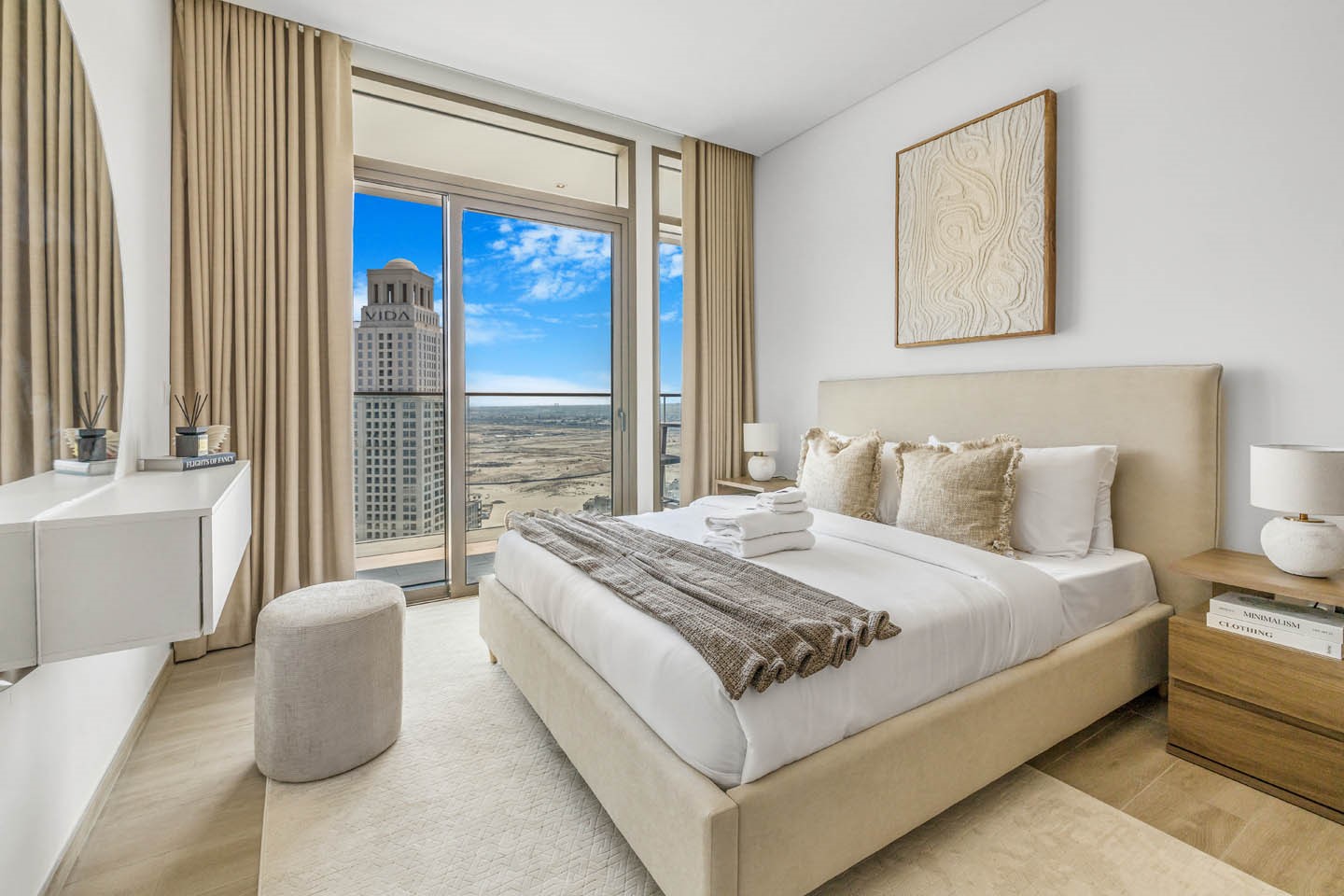
Image by Homevy
But the goal isn’t simply to spend as little as possible. You need to balance upfront cost with durability, guest experience and what happens to the furniture when your lease ends.
Your furniture needs to handle frequent guest use, look good in listing photos and survive repeated turnovers. At the same time, you’re furnishing a property you don’t own.
That makes durability, portability and replacement costs important.
Homevy’s in-house furnishing team, led by KHDA-certified designer Shinnel Johnson, designs and furnishes Dubai holiday homes with short-term rental use in mind.
If you’re deciding between professional furnishing and doing it yourself, see our guide to Airbnb furnishing services vs. DIY.
For an arbitrage property, choose furniture you can take with you. The lease may end, but your investment in the furniture doesn’t have to.
The most expensive arbitrage mistakes often happen before the first booking.
A lease that only works during peak season, unrealistic revenue expectations or too much dependence on one landlord can quickly turn a promising deal into a difficult one.
Here are five mistakes worth avoiding.
December rates in Dubai can look very different from August rates. If you use your strongest month to justify the rent, you may end up with a property that only works when demand is at its highest.
Base your numbers on realistic annual performance, then stress-test the deal against slower months.
Someone showing you AED 20,000 in monthly Airbnb revenue is showing you gross bookings, not necessarily profit.
Rent, platform fees, cleaning, utilities, maintenance and management can take a significant portion of that revenue.
Before signing a lease, work backwards from revenue to actual operating costs.
Some landlords hear “Airbnb” and immediately think parties, noise and complaints.
Your job is to show them how you will operate the property responsibly. Explain your guest screening, cleaning process, insurance, house rules and who they can contact if there is an issue.
You’re not just asking for permission to list a property. You’re presenting a short-term rental business with an operating system.
Airbnb’s host protection isn’t a substitute for proper insurance.
Platform protection comes with its own terms and exclusions, while you’re still responsible for your obligations to the landlord.
Make sure you have appropriate insurance for the property and the way you’re operating it.
Concentration creates another type of risk.
If one landlord sells the property or a building changes its operating procedures, you could lose several units at once instead of just one.
As you grow, spreading your units across different owners and buildings can reduce your exposure to a single change.
The 80/20 rule is the observation that a small share of nights, dates or listings produces most of the revenue.
For arbitrage, that means peak weeks carry your year, and pricing them well matters more than filling every quiet Tuesday. We break it down in our beginner’s guide to Airbnb investing.
In the US, an LLC isn’t always legally required, but many operators form one to separate business and personal liability, and some landlords and insurers expect it.
In Dubai, the question is licensing rather than liability: the permit sits with a licensed holiday home operator or a home owner, so check which structure DET will accept for your setup.
You need cover that explicitly includes paying short-term guests. Standard renter’s insurance usually doesn’t.
Look for liability cover plus protection for guest damage to the property and your own furniture, ideally naming the landlord. Platform guarantees can sit on top, but they shouldn’t be your only layer.
Ask for the company’s DET holiday home licence, confirm the unit will get its own DET permit, and read the payment and termination clauses closely.
Ask what happens to your rent if bookings fall. Then compare that guaranteed figure with what direct short-term management could earn you.
In arbitrage, you lease the property and carry the rent whether or not it books. In co-hosting or property management, the owner keeps the property and the risk, and the manager earns a share of revenue.
Lower upside, much lower exposure. If you’re weighing the two, how Dubai management fees work is a useful starting point.
Before you sign a lease, run the property through our Airbnb Income Calculator. You’ll see whether the potential revenue can justify the rent and operating costs before putting your capital on the line.
If the numbers work, you can move on to the lease, landlord approval and DET requirements with more confidence.
And if you don’t want to figure out the operation alone, Homevy can run the property for you for a 20% management fee with no onboarding fee, covering pricing, guest operations, furnishing, photography and DET permits.
Have a property in mind? Chat with Homevy, and we’ll help you assess the opportunity.


Get access to our 5-day training course on managing your vacation rental property in Dubai.
Download Guide